

Blush / Flow Marks
Blush and flow marks are the result of variations in material temperature, caused by the temperature gradient between machine nozzle and mould sprue bushing.
A halo around the direct sprue entry is the result of cold material in the nozzle tip section. Eliminating the temperature gradient will minimize the blush and halo effects.
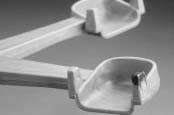
Burn marks / Diesel Effect
Burn marks are often like brown streaks.
They are usually caused by overheating the material due to entrapped air (diesel effect) and this causes the darkening in colour.

Delamination
Separation of layers in the moulded part that can be peeled off. flaking of surface layers. It results from insufficient layer bonding due to inhomogeneities and high shear stresses.

Dimensions of Part
Excessive shrinkage means part dimensions differing from expected ones; amorphous resins behave differently to semi-crystalline materials.
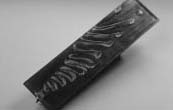
Jetting
A turbulent flow in the resin melt: the melt strand enters the cavity in an uncontrolled way. Due to cooling down, the strand is not fused homogeneously with the melt that follows and it shows as a serpentine line on the part surface.
Too little restriction when filling the cavity, material is injected in empty space.
Pitting
Pitting is the presence of unmelted particles due to difficult dispersion of additives, wrong mixing or crosslinking during processing.

Record Grooves
Resembles the grooves of gramophone records. At slow speed - as material enters cold tool - it loses its flow (below HDT) before actual contact. The melt that follows flows over cooled melt, to repeat the cycle.
Sticking in Cavity
At end of cycle, the moulding does not release from the mould but sticks in the cavity (female mould side).
Sticking on Core
At end of cycle, the moulding does not release from the mould but sticks on the core (male mould side).
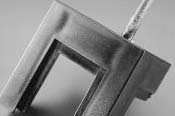
Sink Marks
Visible defects resulting from insufficient cooling before removal from the mould.
A heavy rib intersecting a thin wall may show up sink marks. Quite difficult to eliminate by varying processing conditions.
Too high holding pressure – useless when gating is too small – creates very high stresses in gate areas.
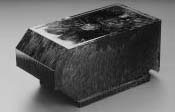
Splay / Streaks
Splay marks, silver streaks, splash marks are the result of:
- moisture on the pellets which should be removed under recommended drying times and temperatures
- products of degradation due to overheating
- residual non-aqueous volatiles in material
(a) and (c) will produce fine lines emanating from the gate all over the part whereas (b) will show up as coarse lines, lumps in sections of the moulded parts.
Voids
Vacuum hollows (‘empty bubbles’) in the moulding, due to thermal shrinkage that draws material away from the fluid core of the part.
Warpage / Distortion
A dimensional deformation of the moulding resulting from frozen-in stress, or because the part was taken too hot from the mould. Basically it is due to pressure differences between areas.

 solutions for
black spots
solutions for
black spots


